Showing posts with label Dennis Rodman. Show all posts

Thursday, September 9, 2010

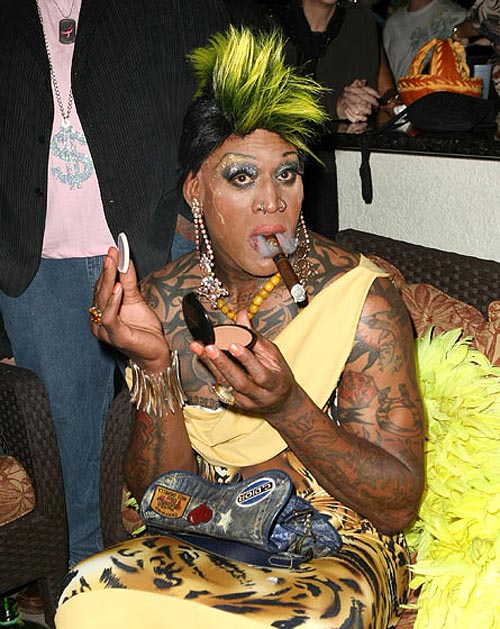
Wait... Dennis Rodman Gets Girls??


Reportedly Dennis Rodman got caught with his pants down on microphone last Sunday. The notorious ex-basketball player had been partying at Hotel Indigo’s pool party and threw a few shoutouts over the mic. Afterwards, he apparently “forgot” the mic was still on AND still in his pocket as he made his way back up to his room with six women. From there I am sure you can guess where this is going: when Rodman’s dirty talk started booming over pool party speakers, the hotel freaked and shut it off immediately.

While Rodman’s reps say it was a mistake and that he had thrown abck a few drinks earlier, I just cannot believe that this was not some form of publicity stunt (pathetic as it may be). It’s not that I don’t think Rodman is stupid enough to make that “mistake”, it’s that I think he’s an F-ing creep and it is highly unbelievable that even one girl, let alone six, would be willing to sacrifice her dignity and public reputation for life just for a “magical” night with Dennis Rodman…. UGH.

Sunday, January 24, 2010

Higher Age Floor, Lower Arrest Levels for NBA?

Last week in one of my posts about cheaters I touched on how very difficult universities can make academics for their athletes. This idea goes hand in hand with what some argue is the need for an older minimum age to enter the NBA; those players who have not gone to college are more likely to get in trouble with the po-po later in their careers. Apparently, a college education is supposed to smarten you up a little – maybe make you rethink hitting your girlfriend like Dennis Rodman, or getting caught with weed like Sheed? The funny thing is both Rodman and Wallace went to college. So what does that mean in terms of a link between higher education and lower arrest rates?

In a study designed to look at the validity of such a claim, researchers actually found that nearly the opposite was true. Out of 84 NBA players who had been arrested, more than half – 48 – had completed four years of college. Of the remaining 36 players, 27 had completed at least two years of college. In fact, out of every arrested NBA player studied, less than 5% had not gone to college at all.

Although NBA Commissioner David Stern has openly pushed to have the age floor raised to 20 years old, there are others like Congressman Steve Cohen who have gone as far as to call the idea “a vestige of slavery” because it constitutes “a restraint on a person’s freedoms and liberties.” I’m not saying I agree with Stern, but I think “a vestige of slavery” is a little dramatic. Let’s take it down a notch, Cohen – we’re talking about picking up high schoolers, not picking cotton. The NBA’s age floor is currently set at 19, which means unless a player has been held back a year, they are pretty much forced to attend at least a year of college before going pro. This rule will be up for reconsideration when it expires next year.

While I think we all know universities don’t exactly kill athletes with workloads or hard classes, after checking out those study results maybe they should consider raising the academic bar slightly as a possible solution in the meantime. If athletes are already getting their own “special” classes (Addition and Subtraction 111, US States 120) why not at least make them relevant to their future careers? I mean, it’s pretty obvious that their current degrees aren’t doing a whole hell of a lot to help them to stay out of trouble. I personally think Hiding Substance Use 425 or Controlling Abusive Urges 315 sound like they’d be pretty popular, and maybe a more practical solution until a verdict is reached in 2011.

Tuesday, November 3, 2009

Don't hate the player, hate the...

Across all professional sports, contract negotiations, player-coach relationships, retirement, and player-player conflicts result in athletes changing their uniforms. The popularity of the player is positively correlated with the outrage of the old team and the excitement of the new team. Switching teams is not, by any means, a new sensation. Usually, a trade makes a small wave within the organization that ripples out into the public for a week at the most. When great players are traded, however, it is a different story. Over the course of five weeks, we are taking a look at five significant cases. The first was Brett Favre, the second was Wayne Gretzky, and the third was Patrick Ewing. The fourth is Michael Jordan.

1984-1993, 1995-1998: Chicago Bulls
2001-2003: Washington Wizards

Michael Jordan was a star from the start, being named to the NBA All-Star Team during his first season and receiving the Rookie of the Year Award as well. Since joining the Chicago Bulls in 1984, “His Airness” has received a plethora of accolades and has achieved a multitude of statistical accomplishments. However, what on the surface appears to be a smooth career was in fact marred by two retirements.

Jordan and the Bulls won their first Championship together in 1991, and went on to win two more in 1992 and 1993, giving the Bulls three consecutive titles. Excitement soon led to despair when Jordan announced his retirement from basketball on October 6, 1993 at age 30. Spurred by his father’s death and claiming a lack of desire, Jordan told the press, “I just feel that I don’t have anything else to prove.”

During his hiatus, Jordan joined the baseball team the Birmingham Barons, which are part of the Chicago White Sox minor league system. Less than successful, on March 18, 1995, Jordan announced that he was returning to the NBA and would rejoin the Chicago Bulls. Although the Bulls made it to the playoffs, Jordan did not win a title upon his return. In better condition for the 1995-1996 season, Jordan, supported by teammates Scottie Pippen and Dennis Rodman, led the Bulls to three more consecutive championships in 1996, 1997, and 1998.

The three-peat high did not last too long, however, when Jordan announced a second retirement in 1999. Unable to stay away from basketball, in 2000, Jordan took on a professional position as President of Basketball Operations for the Washington Wizards. Watching his team fail and feeling inspired by his friend Mario Lemieux’s NHL comeback, Jordan was anxious to get back on the court. He signed a two-year contract with his new team, the Washington Wizards, and he hired former Bulls’ coach Doug Collins. Unfortunately, Jordan’s return did not revive the Wizards in the way he had hoped—they never made the playoffs. However, he did score 40 points at age 40 during the 2002-2003 season, after which he retired for a third and final time.

Air Jordan is still a household name and will forever remain the childhood hero of millions. He is one of the greatest athletes of the 20th century, ranked number one above Babe Ruth and Muhammad Ali. His retirements were possibly the least controversial of those discussed in this series. However, they will forever taint an otherwise stunning and incredible tenure of one of the best, if not the best, players in NBA history.